I Thought I Had Found a Shortcut to Success. I Had Actually Found a Pattern.
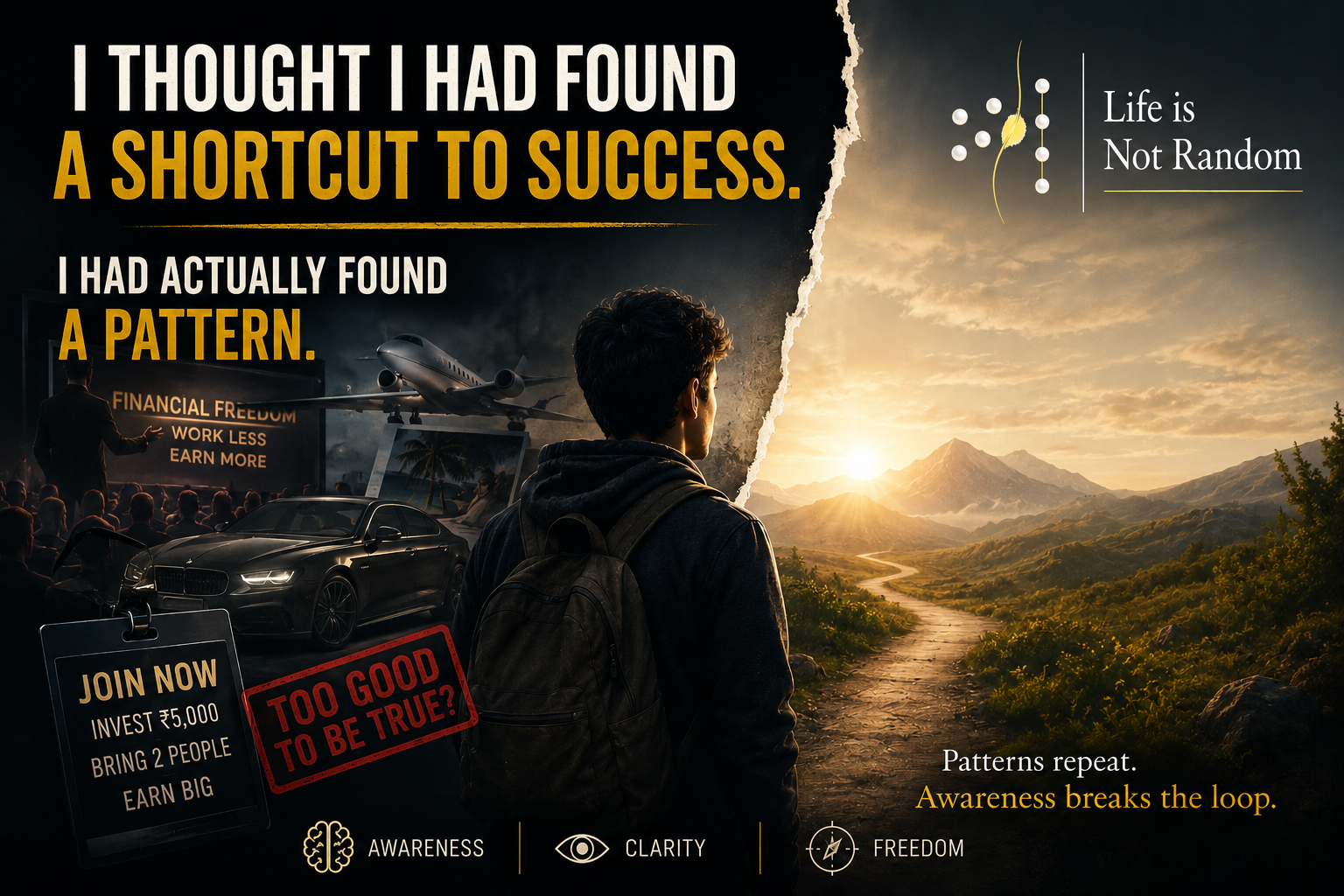
Luxury cars. International holidays. Financial freedom. Looking back, the signs were everywhere.
Why do so many people join MLMs, pyramid schemes, and get-rich-quick opportunities?
It's tempting to assume the answer is greed.
I don't think that's true.
Most people don't join because they're greedy.
They join because they're hopeful.
They want a better future.
They want financial freedom.
They want to believe they've found a shortcut that others have missed.
I know because, years ago, I almost did.
When I was in college, a senior approached me with what sounded like the opportunity of a lifetime.
"Just invest ₹9,000. Bring in two people. They bring in two more. Then sit back and earn."
It sounded simple.
And more importantly, it sounded possible.
He showed me charts.
Success stories.
Income projections.
People who had supposedly transformed their lives.
The message was clear.
This wasn't just a business opportunity.
This was a faster way to reach the future I wanted.
I borrowed the money.
Then I did something worse.
I convinced two friends to join with me.
At the time, it didn't feel irresponsible.
It felt exciting.
For weeks, I attended meetings filled with energy and certainty.
People talked about luxury cars.
Foreign trips.
Passive income.
Financial freedom before the age of thirty.
Everyone seemed convinced.
And when enough people believe something, it becomes surprisingly easy to believe it too.
Then one day, everything disappeared.
The company vanished.
No office.
No answers.
No refunds.
The money was gone.
But that wasn't the part that stayed with me.
What stayed with me was knowing that I had convinced my friends to trust something I never fully understood myself.
That feeling lasted much longer than the financial loss.
For years, I thought that experience taught me a lesson about MLMs.
Later, I realized it had taught me something much bigger.
The MLM wasn't the real lesson.
The lesson was about human behaviour.
Because when I looked back honestly, I could see that questions had appeared long before the company disappeared.
How exactly does this business make money?
Why are people talking more about recruitment than customers?
Why does everyone seem more interested in selling the opportunity than the product?
What happens when growth stops?
The questions were there.
I just wasn't paying much attention to them.
The dream was louder.
The possibility of success was more exciting than the discomfort of doubt.
The stronger the dream, the weaker my questions became.
I've since noticed the same pattern far beyond MLMs.
People ignore warning signs in relationships because they desperately want the relationship to work.
Investors overlook obvious risks because they desperately want high returns.
Entrepreneurs convince themselves that a flawed opportunity is perfect because they desperately want success.
Different situations.
Different stories.
The same pattern underneath.
We often think poor decisions happen because people lack information.
But many times, the information is already there.
What's missing isn't information.
It's the willingness to look at it honestly.
Especially when the truth threatens a future we desperately want to believe in.
That's why pyramid schemes and get-rich-quick opportunities can be so persuasive.
They don't just sell money.
They sell relief.
Relief from uncertainty.
Relief from slow progress.
Relief from the uncomfortable reality that meaningful success usually takes time.
And when something promises relief from all of that, it's easy to stop asking difficult questions.
Today, whenever something sounds too perfect, I pay attention.
Not just to the opportunity.
To myself.
Am I seeing this clearly?
Or am I seeing what I want to see?
Because the biggest risks rarely arrive disguised as risks.
They arrive disguised as exactly what we've been hoping for.
Looking back, I don't regret attending those meetings.
In a strange way, I'm grateful for them.
They taught me something I would spend years noticing in different forms.
The opportunities change.
The stories change.
The promises change.
But human behaviour often follows the same patterns.
And once you learn to recognize those patterns, you start seeing things that were always there.
Not just in business.
In life.
— Pushpender Kaushik
Exploring patterns in business, behaviour, and life.
🌐 lifeisnotrandom.com