I Think I Knew the Answer Much Earlier Than I Admitted.
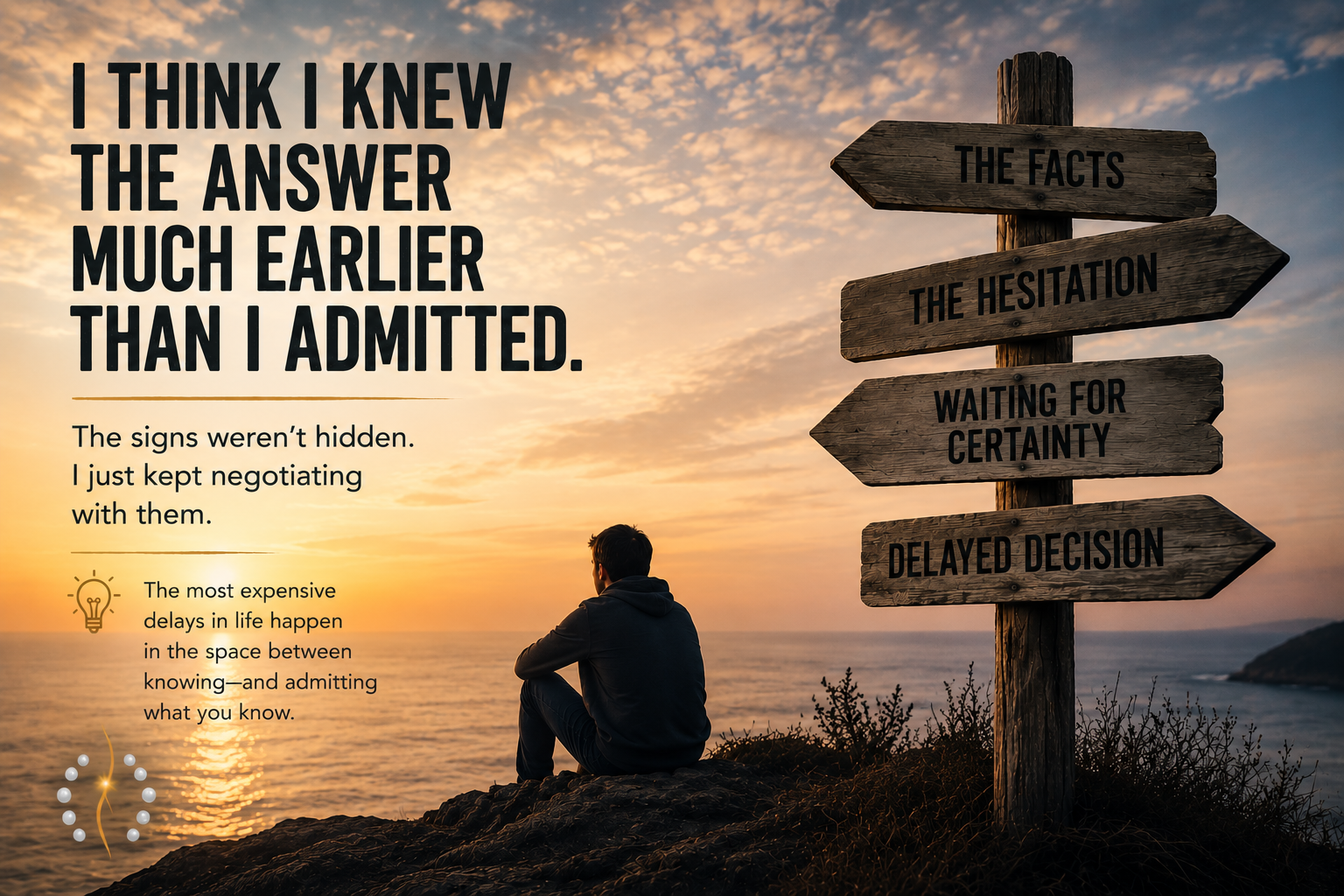
Looking back, the signs weren't hidden. I just kept negotiating with them.
Why do we ignore obvious signs even when we sense something is wrong?
Most of the time, it isn't because we lack information.
It's because we're waiting for certainty.
We want more proof.
More time.
A clearer warning.
Looking back on many of my own decisions—in business, money, and life—I realized something uncomfortable:
I often knew the answer much earlier than I admitted to myself.
For years, I thought good decisions came from having enough information.
If I could just gather a little more data, think a little longer, or wait a little longer, the right answer would eventually become obvious.
That sounds rational.
Sometimes it is.
But I've noticed something else.
Many of the decisions that shaped my life weren't delayed because I lacked information.
They were delayed because I didn't like what the information was already telling me.
### Why Do We Ignore What We Already Know?
There is a moment before most mistakes become visible.
A moment when something feels slightly off.
Not wrong enough to stop.
Not clear enough to explain.
Just enough to create a quiet hesitation.
I've felt that hesitation many times.
In business partnerships that looked promising.
In opportunities where everyone around me seemed confident, but something inside me wasn't fully convinced.
In situations where everything looked right on paper, yet something didn't feel fully aligned.
Because nothing looked obviously broken, I kept moving forward.
Years ago, when I was in college, I became involved in an MLM opportunity.
Like many people who enter those systems, I wasn't looking for trouble.
I was looking for possibility.
The presentation sounded convincing.
The success stories sounded real.
The promise of financial freedom arrived wrapped in certainty.
And if I'm honest, there were moments when parts of it didn't feel completely right.
Questions appeared.
Small doubts surfaced.
But I kept explaining them away.
Because I wanted the outcome to be true.
Looking back, the problem wasn't that I had no warning.
The problem was that I kept negotiating with the warning.
### The Difference Between Information and Certainty
That's the distinction I didn't understand then.
Information and certainty are not the same thing.
Information often arrives much earlier than certainty.
The problem is that we keep waiting for certainty before trusting the information.
We tell ourselves:
Maybe I need more proof.
Maybe I'm overthinking.
Maybe things will become clearer later.
Sometimes they do.
But often, the information is already there.
We're just waiting for certainty to remove the risk of being wrong.
I've seen this pattern repeat in completely different situations.
A partnership where communication felt slightly misaligned from the beginning.
An opportunity that looked attractive but never felt fully right.
A conversation where someone's words sounded convincing, but their actions quietly told a different story.
In each case, I found myself doing the same thing.
Collecting more evidence.
Waiting longer.
Asking for one more sign.
Not because I didn't know enough.
Because I wasn't ready to act on what I already knew.
### Why We Keep Negotiating With Red Flags
I don't think most people do this because they're careless.
I think we do it because the truth has consequences.
Once you admit something isn't right, a decision becomes necessary.
You may need to walk away.
Speak up.
Change direction.
Let go of an expectation you've been holding onto.
And that's where things become uncomfortable.
Looking back, I wasn't always afraid of being wrong.
Sometimes I was afraid of what being right would require me to do.
If the warning was real, I couldn't pretend not to see it anymore.
If the situation wasn't right, I had to make a change.
And change usually costs more in the short term than postponement.
So I postponed.
Not consciously.
But repeatedly.
### What Changed When I Started Paying Attention?
Not everything.
I still make mistakes.
I still miss things.
I still occasionally convince myself that one more piece of evidence will somehow make a difficult decision easier.
But my relationship with hesitation has changed.
I pay more attention to it now.
Not because every uncomfortable feeling is correct.
And not because intuition is always right.
But because ignoring those signals has its own cost.
I've learned that awareness deserves attention even when certainty hasn't arrived yet.
The biggest lesson wasn't learning how to predict the future.
It was realizing how often I already knew enough.
The signs weren't hidden.
The answers weren't absent.
I was simply waiting for certainty when awareness was already available.
And sometimes the most expensive delays in life happen in the space between knowing—
and admitting what you know.
Think about a decision you've been delaying.
A conversation.
A commitment.
A change you've been considering for months—or maybe years.
Are you truly missing information?
Or are you waiting for certainty?
— Pushpender Kaushik
Exploring patterns in business, behaviour, and life.
🌐 lifeisnotrandom.com